The Landscape of Self-Reflection Tools: Evaluating the Self Discovery 50 Creative Writing Journal
In the broad category of personal development resources, guided journals occupy a distinct and popular space. They offer structure for those seeking introspection without the daunting prospect of a blank page. The Self Discovery 50 Creative Writing journal presents itself as a specific tool within this niche, designed to facilitate a journey of self-exploration through written prompts. Understanding its particular features, format, and intended use case is crucial for anyone comparing options for self-reflection practices.
What Defines the Self Discovery 50 Creative Writing Approach
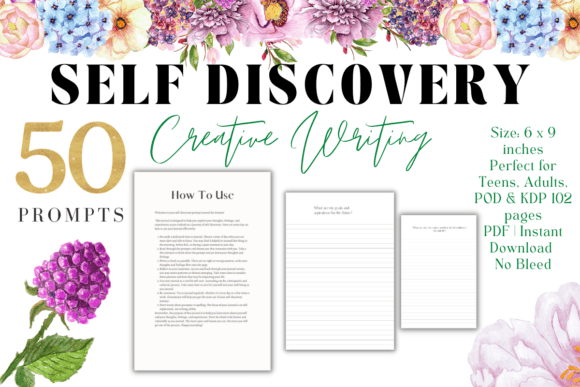
At its core, Self Discovery 50 Creative Writing is a prompt-based journal. It provides 50 distinct writing prompts aimed at encouraging introspection across a spectrum of topics. The journal’s description indicates a focus on areas like core values, goals, personal strengths and weaknesses, passions, and relationships. This thematic range suggests it is designed for broad, foundational self-assessment rather than deep diving into a single, specialized area like grief, career planning, or creative fiction.
A key characteristic is its format: a 102-page, 6x9 inch PDF designed for instant download. This digital, print-ready format is a significant point of comparison with physical products. It offers immediate access and allows for personal printing, but it inherently differs from a pre-bound, professionally manufactured notebook. The journal is noted as being "KDP Approved," which typically relates to Amazon’s Kindle Direct Publishing platform, indicating it is structured to meet specific technical requirements for print-on-demand services.
Strengths and Distinctive Attributes
The primary strength of Self Discovery 50 Creative Writing lies in its curated prompts. For individuals unsure where to begin their self-reflection, or who find open-ended journaling overwhelming, a set of 50 guiding questions can effectively bridge the gap between intention and action. The compact page count and prompt number suggest a paced approach—not an exhaustive, daily-year-long commitment, but a structured series of explorations.
Its digital nature offers practical advantages. It is portable in the sense of file transferability; you can access it from multiple devices and print copies as needed. For those who prefer to write on different paper types or in varied settings, this flexibility can be a benefit. The "No Bleed" specification is a technical point relevant to those who intend to print the journal themselves, ensuring graphics or borders won’t be cut off during home or professional printing.
Considering Tradeoffs and Limitations
Every tool involves tradeoffs, and the digital PDF format of Self Discovery 50 Creative Writing presents several. While portable as a file, it lacks the tactile, ready-to-use convenience of a pre-purchased physical journal. The user must take the additional steps of printing and binding, which involves cost, time, and decision-making about paper quality and binding method. This contrasts with purchased journals that arrive as a finished product.
The prompt-based structure, while helpful for guidance, may also be a limitation for some writing styles. Individuals who prefer free-form, stream-of-consciousness writing, or who want to revisit and expand on the same themes over many pages, might find the prompt-per-page format restrictive. The 102-page count suggests approximately two pages per prompt, which may be sufficient for some but insufficient for others who engage deeply with a single question.
Comparison with Other Self-Reflection Formats
When evaluating Self Discovery 50 Creative Writing, it is useful to consider it against other common formats in the self-discovery toolkit.
Traditional Blank Journals: These offer maximum freedom but require self-direction. For a person with clear internal motivation and a established writing habit, a blank journal might offer more long-term value. Self Discovery 50 Creative Writing is better suited for those who need an external catalyst to begin or structure their process.
Specialized Topic Journals: Many journals focus intensively on one area—mindfulness, gratitude, career transition, or artistic development. The Self Discovery 50 Creative Writing journal, with its broad range of topics, serves as a generalist tool. It is a fit for someone seeking a wide-ranging self-audit, but may not satisfy someone looking to excavate a single, complex life area.
Apps and Digital Platforms: Numerous apps offer daily prompts, mood tracking, and secure digital journaling. The Self Discovery PDF is static and analog in use—it encourages writing by hand once printed. This can be a deliberate benefit for those seeking a screen-free, tactile reflective practice, but it lacks the features of reminders, cloud backup, or data analysis that digital apps provide.
Community or Course-Based Programs: Some approaches to self-discovery involve guided groups, workshops, or online courses. The journal is a solitary, asynchronous tool. It offers privacy and low cost but does not provide the accountability, feedback, or shared insight that a community setting can foster.
Identifying the Best-Fit Situations
Determining whether Self Discovery 50 Creative Writing is the right resource depends heavily on individual circumstances, preferences, and goals.
It may be a strong choice for:
- Beginners to structured self-reflection who value clear starting points over open-ended exploration.
- Individuals who prefer handwritten journaling but want more guidance than a blank notebook provides.
- Those with specific printing or binding preferences, who enjoy customizing their physical journal’s appearance and paper quality.
- People seeking a compact, focused project—50 prompts represent a definable commitment, unlike an ongoing daily journal.
- Users integrated with the KDP or POD ecosystem, who intend to use the journal as a base for creating a physical product to sell or keep.
Conversely, readers might need to consider another option if:
- They require deep, ongoing exploration of a niche topic (e.g., healing from a specific trauma, detailed business planning).
- They strongly prefer the convenience of a pre-bound, ready-to-use physical book and do not wish to manage printing.
- Their self-reflection practice thrives on absolute freedom and they find predefined prompts constraining or distracting.
- They desire integrated digital features like prompts delivered via an app, encryption, or multimedia journaling capabilities.
- They seek social interaction or expert guidance as part of their discovery process.
Practical Factors in the Decision Process
Making an informed choice involves weighing several tangible factors. For the Self Discovery 50 Creative Writing journal, consider the practical implications of the PDF format. Do you have access to a reliable printer and preferrable paper? Are you comfortable with the cost of printing 102 pages? Would you bind it as a simple stapled booklet, use a three-ring binder, or invest in professional printing services? These logistical considerations are inherent to the product.
Also, evaluate the prompt style. While the listed topics are broad, the actual wording and depth of the 50 prompts are critical. A prospective user might wish to compare the approach of these prompts—are they primarily list-making, essay-style, creative, or analytical? Without seeing the specific prompts, one must infer from the description whether they align with your preferred mode of thinking. Some journals lean toward artistic expression, others toward logical self-audit.
Finally, assess the commitment level. Fifty prompts can be completed in a focused period or spread out over months. The journal’s structure likely encourages a linear progression, which can be beneficial for building a habit. However, if your self-discovery needs are intermittent or highly variable in focus, a more flexible, non-linear resource might be better.
Concluding Thoughts on Informed Selection
The journey of self-discovery is personal, and the tools we choose should align with our practical realities and internal processes. The Self Discovery 50 Creative Writing journal occupies a specific point in the market: a digital, prompt-driven, generalist self-reflection guide designed for physical printing. Its strengths are in providing structured entry points into introspection and offering format flexibility. Its tradeoffs revolve around the user’s responsibility for physical production and the potential constraints of a predefined prompt sequence.
When comparing resources, it is helpful to delineate needs along axes like format (digital vs. physical), structure (guided vs. free-form), topic breadth (general vs. specialized), and required commitment level. By honestly assessing where your preferences lie on these spectra, you can determine whether a tool like Self Discovery 50 Creative Writing is a suitable match or if your needs point toward a different category of resource. The goal is not to find the "best" tool universally, but the most appropriate one for your unique path of exploration.