The Art of Tracking Time: Navigating Options for Personal Productivity
In the pursuit of productivity, whether for personal projects, freelance work, or simply managing household responsibilities, the act of consciously tracking time is a foundational skill. Many individuals find themselves exploring various methods to log their hours, from sophisticated digital apps to simple paper notes. Among these options, the concept of a dedicated Project Time Log or Project Tracker represents a specific, tangible approach. This article examines this method, its distinct characteristics, and how it compares to the broader landscape of time management tools to help you determine the best fit for your needs.
What is a Project Time Log or Tracker?
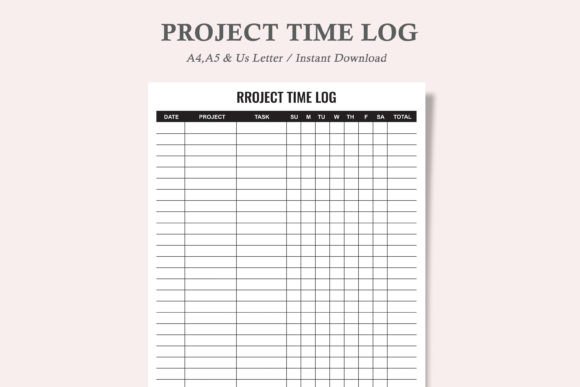
A Project Time Log, in its essence, is a structured document designed to record activities against specific time increments. Unlike a general to-do list or calendar, its primary function is chronological logging—capturing what you did and when you did it. The specific example we’re considering here is a printable form that includes seven days of the week with space to note a small chore or activity per day, by the hour. It is offered in multiple formats (PDF and JPEG) and sizes (US Letter, A4, A5), featuring a professional, minimalist, and ink-friendly design. Its core value proposition is simplicity and repetition: you print a new page whenever you need one, creating a consistent paper trail of your effort.
What makes this distinct from a generic notebook entry is its pre-formatted structure. It imposes a gentle framework, encouraging you to think in terms of discrete hours and daily tasks. This can be particularly useful for those who find completely free-form journaling too unstructured or digital interfaces too distracting. The Project Tracker aspect comes from the cumulative effect of using these logs over time, allowing you to review past weeks and observe patterns in your productivity and time allocation.
Comparing Approaches: Paper vs. Digital
When evaluating time tracking methods, the primary axis of comparison is often the medium: physical paper versus digital applications. Each has inherent tradeoffs that significantly impact your workflow.
The printable Project Time Log firmly belongs to the paper-based category. Its strengths are tactile and cognitive. Writing physically can enhance memory and engagement with the task. It requires no battery, software updates, or login screens, offering immediate, frictionless access. For individuals sensitive to screen time or those who prefer a ritualistic start to their workday—opening a binder, picking up a pen—this can be a meaningful advantage. Furthermore, the “ink-friendly design” suggests a practical consideration for cost and ease, as it’s intended for frequent home printing.
However, the limitations are equally clear. Paper logs lack automation. There is no automatic calculation of total hours per project, no pop-up reminders, and no easy search function. Data analysis becomes a manual process. If you need to generate a client report or analyze time spent on a specific activity over a month, you must compile information from multiple sheets yourself. This can be a significant drawback for freelancers or consultants who bill by the hour and require efficient summarization.
Digital Alternatives: A Spectrum of Complexity
Digital time trackers range from simple timer apps to comprehensive project management suites. Their universal benefit is data portability and potential for integration. Time entries can often be tagged to specific projects, clients, or tasks, and reports can be generated instantly. Many apps also offer features like idle detection, pomodoro timers, or integration with calendar and invoicing software.
The tradeoff here is often complexity and cognitive overhead. A feature-rich application can become a project to manage itself. Notification prompts can feel intrusive, and the act of switching between a work task and the tracking app can itself break concentration. For someone managing simple personal projects or household chores, a sophisticated digital tool might feel over-engineered, adding more process than value. The choice between a minimalist printable PDF and a full digital suite hinges on your need for analysis versus your desire for simplicity and focus during the work itself.
Fit and Application: When is a Printable Log the Right Choice?
Determining whether this specific Project Time Log format is suitable for you depends on your goals, work style, and the nature of your projects.
It appears to be an excellent fit for individuals engaged in activities where hourly awareness is beneficial, but deep data analysis is secondary. Consider a student tracking study hours across different subjects, a writer logging dedicated writing sessions to build a routine, or a homeowner planning and executing a week of renovation tasks. The “small chore or activity” focus suggests it’s geared towards granular, daily progress rather than large, multi-phase corporate projects. Its design promotes mindfulness—you consciously fill each hour slot, which can deter procrastination and increase accountability to yourself.
The inclusion of three standard sizes (US Letter, A4, A5) is a practical feature that acknowledges different user preferences. The A5 size, for instance, is highly portable, fitting easily into a small notebook or planner, making it suitable for people who track time on the go or in different locations.
Potential Limitations and Decision Factors
You might need to consider another option if your requirements extend beyond basic logging. Key decision factors include:
- Collaboration: Are you tracking time for a team? Paper logs are inherently individual. Shared projects typically require a digital platform where multiple people can input and view data.
- Integration Needs: Do you need your time data to feed directly into an invoicing system, payroll software, or project timeline? If yes, a digital tool with export/API capabilities is necessary.
- Scale and Analysis: If you are managing dozens of simultaneous tasks or clients, and you require weekly/monthly comparative reports, the manual compilation from paper sheets could become an untenable time sink.
- Accessibility & Backup: Paper can be lost, damaged, or misplaced. Digital logs, stored in the cloud, offer inherent backup and access from any device, which is crucial for business-critical time accounting.
Beyond the Form: The Philosophy of Time Tracking
Evaluating any tool, including this Project Time Log, is also about understanding the underlying principle it serves. Time tracking is not merely administrative; it’s a form of self-observation. A minimalist paper tracker forces you to be the analyst. You review your week, see blank hours (potential wasted time), and clusters of activity (productive peaks), and you draw your own conclusions. This active reflection can be more insightful than passively receiving an automated dashboard.
Conversely, digital tools can provide a more passive and precise tracking experience, ideal for when the primary goal is accurate record-keeping for external purposes (e.g., client billing). The “Digital Editable PDF” version mentioned in the features bridges these worlds slightly, allowing for digital filling and saving, which might appeal to those who want structure but prefer to keep files on their computer rather than in a physical folder.
Making an Informed Choice
Ultimately, the decision between using a printable Project Tracker or another method rests on a balance of simplicity versus functionality. If your priority is to establish a low-friction, mindful habit of time awareness for personal or straightforward projects, a well-designed printable log offers a focused path. It removes the distraction of software features you don’t need and centers the practice on the act of logging itself.
If, however, your time tracking is a component of a larger, more complex professional workflow involving collaboration, financial reporting, or deep analytics, then investing in a dedicated digital solution will likely save you time and provide greater utility in the long run. The key is to match the tool’s capabilities to the true complexity of your task—avoiding both the underpowered frustration of a too-simple tool and the overwhelmed fatigue of a too-complex one.
By understanding the distinct role of a structured paper log, its comparative strengths against digital ecosystems, and the realistic scenarios where it shines or falls short, you can make a more grounded choice in your search for an effective time management resource. Whether you opt for this printable format or another alternative, the most important step is committing to the practice of observation, using the tool that best supports your focus and your goals.